
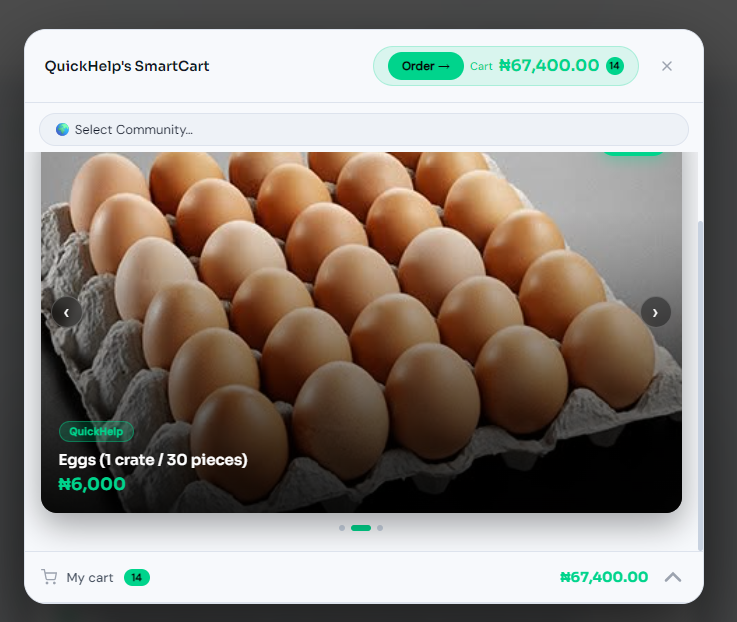
For years, online shopping has followed the same pattern everywhere in the world. You browse a catalog, click into a product page, add it to a cart, go to a checkout page, fill in a form, and wait for a confirmation email. This is the format most e-commerce platforms inherited from the early 2000s, and even though the designs have gotten prettier, the actual journey has barely changed. QuickHelp’s SmartCart breaks away from this completely. It offers a real look at what community-based online shopping can be when it is built around how people in places like Nigeria actually chat, share, and pay.
Shopping Inside the Conversation, Not Outside It
The boldest decision behind SmartCart is where it lives. It is not a separate website you have to visit. It sits inside the same AI chat window that QuickHelp users already open to ask about emergency contacts, find a local business, or buy airtime. One tap on “Shop” opens a full community marketplace without leaving the conversation. No new tab, no separate login, no starting over somewhere else. The chat itself becomes the store.
This is a bigger deal than it sounds. Most online stores assume the shopper already knows exactly what they want before they even open the app. SmartCart is built for something more realistic: the moment when the idea to buy something comes up in the middle of a totally different conversation. A user chatting with QuickHelp about something unrelated can discover a featured product, add it to their cart, and complete an order, all without leaving that same chat thread.
A Cart Built Around Community, Not Just Categories
Most online stores organize products by category. SmartCart organizes them by community, the actual local markets people already belong to and trust. A student on OAU campus sees familiar spots like Angola, Mozambique, and Road 7. Someone in Ile-Ife town sees Sabo, Mayfair, and Lagere. This is not just a nice touch. It changes what browsing even means. Instead of scrolling through a national list hoping something is deliverable to you, the shopper starts from a community they already recognize, filled with sellers who are physically close to them.
A Cart That Follows You Everywhere
One of SmartCart’s quietest but most important achievements is that the cart is no longer trapped inside a single browser tab. Add an item from a product link shared over WhatsApp, and that same item is already sitting in the cart when you open the main QuickHelp site later. Clear the cart from the homepage, and it clears everywhere too. The cart is not just something you see on a screen. It is a shared, synced state that follows the shopper across every part of QuickHelp, without needing an account, a password, or an app download.
Checkout Without a Checkout Page
Instead of ending on a payment gateway, SmartCart’s order flow ends inside WhatsApp, the app Nigerians already trust for negotiating, confirming, and sending receipts. The order automatically puts together the cart items, delivery fee, seller’s community, and the buyer’s payment details into one clear message, and opens it directly in WhatsApp with a single tap. There is no card to type in, no unfamiliar payment page, no redirect to somewhere else. In a market where trust is built through direct conversation, and where bank transfers and mobile money matter far more than card payments, this WhatsApp-based checkout is not a shortcut. It is simply the right way to build it.
Discovery Made Effortless with “Tap to shop”!
Even before a shopper picks a community, SmartCart shows a rotating display of featured products with clear images, live prices, and a one-tap “add to cart” button. Tapping on any product opens a full-screen view with its description, price, an instant add-to-cart option, and a share button that generates its own standalone product page, complete with a proper preview when shared on WhatsApp, Facebook, or X. Every one of these places, the chat, the full-screen view, the shared link, all read from and write to the exact same cart. The shopper never has to think about which “version” of the store they are using, because there really is only one.
There is also a small detail that makes the whole experience feel effortless: tap to shop. A shopper does not need to open a keyboard, type a number, or fiddle with a quantity box. Every tap on a product simply adds one more to the cart. Want three tins of milk? Tap it three times. The cart quietly keeps count in the background, and the total updates instantly. It sounds simple, almost too simple, but that is exactly the point. Shopping should feel as natural as tapping something you want, again and again, until you have enough.
Not Just a New Feature, a New Standard
What makes SmartCart genuinely important is not any one part of it on its own. It is the fact that every piece was designed around a single idea: online shopping should adapt to how people already talk, share, and trust each other, instead of forcing people to adapt to how stores are usually built. It replaces the lonely storefront with a marketplace built into everyday conversation. It replaces the abandoned cart with one that follows the shopper wherever they go. It replaces the anonymous checkout with a payment flow built on a channel people already trust.
That is the quiet shift QuickHelp has made. Not just a better online store, but a genuinely different idea of what an online store should even be. And the entire idea is “open source”. Just copy and enjoy before your beloved cart gets obsolete.
That is not all. What if the whole system can actually now dissolve into one simple and highly interactive conversation, everything within a chat? Watch out.
Wanna try? Click here